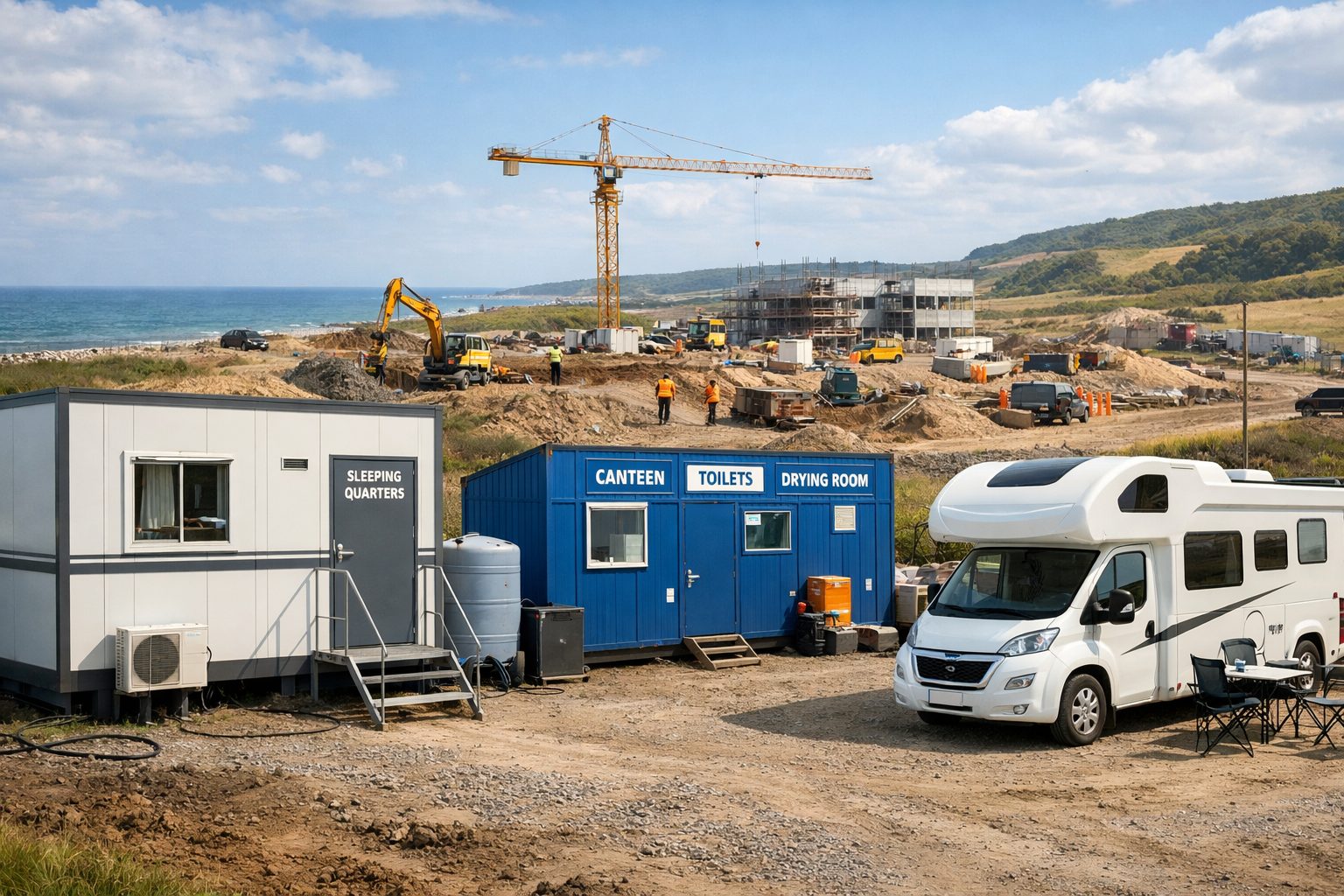
Mobile accommodation solutions are temporary living, welfare, and working facilities that allow construction teams to operate effectively when a site is far from towns, housing, or permanent infrastructure.
On remote projects, accommodation is not about comfort. It is a productivity decision.
Long travel times, unreliable local housing, and limited services quickly turn into safety risks, schedule slippage, and workforce fatigue.
UK construction projects increasingly push into rural, coastal, and infrastructure-heavy regions, where daily commuting is neither efficient nor realistic.
This is why site accommodation is now planned alongside temporary power, access roads, and logistics.
The proper setup keeps crews rested, keeps supervisors close to decision points, and keeps projects moving even when weather, distance, or seasonal pressure complicate delivery.
This guide explains why remote sites rely on mobile accommodation, what types are available, where motorhomes realistically fit, how costs behave, and how to choose the right solution without overbuilding or underplanning.
Why Do Remote Construction Sites Need Mobile Accommodation Solutions?
Remote construction sites need mobile accommodation solutions because distance makes daily commuting inefficient, unreliable, and physically demanding for workers.
When teams spend hours travelling before and after shifts, fatigue increases while productive time shrinks.
Remote work also removes the assumption that basic services are readily available nearby.
Toilets, washing facilities, rest space, and food preparation still need to be provided, regardless of location.
Without planned accommodation and welfare, crews improvise, and improvised welfare rarely survives poor weather or schedule pressure.
There is also a commercial impact.
Late starts, early departures, higher staff turnover, and short-notice absences quietly drain project margins.
Accommodation placed close to the site stabilises attendance, improves morale, and protects output in ways that are hard to replace later.
What Types of Mobile Accommodation Are Used on Remote Construction Sites?
Mobile accommodation is a category of temporary facilities that provide sleeping, welfare, and working space close to a construction site.
The main types used on remote projects are modular accommodation units, portable cabins and welfare units, motorhomes and campervans, and larger temporary lodging arrangements.
Each option solves a different problem.
Some prioritise speed and mobility, while others focus on capacity and long-term stability.
The best choice depends on workforce size, project duration, site movement, and how much infrastructure you can realistically support.
Small, fast-moving teams benefit from flexibility.
Larger projects benefit from standardisation.
Many successful sites combine multiple solutions to adapt to changing needs over time.
Static Modular Accommodation Units
Static modular accommodation units are pre-built modules assembled on site to create sleeping, welfare, and office spaces.
They are commonly used for medium- to long-term projects where headcount is predictable, and the site footprint remains stable.
Typical units include sleeping cabins, sanitation blocks, drying rooms, canteens, and office modules.
Because these units are designed for repeated deployment, they scale well as projects grow.
Modular accommodation supports structured maintenance, cleaning, and welfare inspections, which become essential when multiple subcontractors are involved.
The trade-off is flexibility.
Modules require delivery planning, suitable ground, and access for installation, making them less responsive to sudden site changes.
Portable Cabins and Welfare Units
Portable cabins and welfare units are relocatable facilities that provide essential welfare facilities, including toilets, washing areas, rest spaces, and basic catering.
They are often the fastest way to achieve welfare compliance on remote sites.
Common types include combined welfare cabins, toilet blocks, drying rooms, and canteen units.
These are well-suited to short- and medium-term projects or sites that move as work progresses.
Even when workers sleep off-site, welfare units remain essential during working hours.
They bridge the gap between accommodation and the workface, ensuring crews have consistent access to rest and hygiene without leaving the site.
Motorhomes and Campervans for Construction Use
Motorhomes and campervans are self-contained vehicles that combine sleeping, cooking, and basic washing facilities in a mobile format.
In construction, they are most effective for small teams, supervisors, engineers, and rotational staff working on remote or shifting sites.
Their strength lies in flexibility.
A motorhome can function as overnight accommodation, a mobile site office, or a temporary base during early mobilisation.
They reduce reliance on local hotels and eliminate long daily commutes that often undermine productivity.
Condition and layout matter more than brand.
Insulation, heating, storage, and reliability determine whether the vehicle supports work or becomes a distraction.
Exploring used motorhomes helps teams understand what specifications realistically suit year-round site use.
Procurement teams often encounter consumer-facing terminology that still translates directly into construction needs, including references to motorhome dealers, UK motorhome dealerships, used motorhomes for sale, two- and three-berth layouts, automatic campervans, low-profile motorhomes, end-lounge designs, island-bed layouts, and vehicles with rear garages for equipment storage.
Temporary Lodging and On-Site Housing Solutions
Temporary lodging solutions place workers in rented housing, serviced accommodation, or dedicated temporary housing near a project.
They are most common on long-duration or large-scale projects where workforce stability is a priority.
Options include rented houses, serviced apartments, extended-stay hotels, and purpose-built worker accommodation.
These arrangements offer higher comfort and routine, which supports retention and well-being.
However, availability and cost fluctuate sharply in rural or seasonal areas.
As project footprints shift, accommodation contracts can lag behind site needs, leading to inefficiencies if not actively managed.
What Are the Main Advantages of Mobile Accommodation for Construction Projects?
Mobile accommodation improves productivity, reduces travel strain, and stabilises workforce attendance on remote sites.
It also supports consistent welfare standards regardless of location.
There are 5 key advantages of mobile accommodation:
- Reduce travel and lodging costs by cutting repeated hotel stays and long commutes
- Improve workforce availability through proximity to the workface
- Increase site flexibility as facilities can move or scale with the project
- Enhance worker comfort and safety by supporting rest and hygiene
- Enable faster mobilisation before permanent infrastructure exists
What Are the Limitations of Mobile Accommodation on Remote Sites?
Mobile accommodation introduces constraints around utilities, capacity, and maintenance, especially in isolated locations.
Poor planning amplifies these issues.
There are 4 main limitations:
- Increase infrastructure demands for power, water, and waste
- Limit capacity as workforce size grows
- Create compliance risks if welfare standards are overlooked
- Raise long-term costs when temporary setups become semi-permanent
Motorhomes vs Modular Accommodation Units: Which Works Better for Remote Construction Sites?
Motorhomes are better for mobility and rapid deployment, while modular units are better suited to scale and long-term stability.
The difference is operational control.
Motorhomes support fast-changing sites and small teams.
They are quick to deploy but limited in capacity and consistency.
Modular units require planning but deliver predictable welfare, easier compliance, and scalability.
They integrate well into structured site management.
FactorMotorhomesModular Units
Best use: Small teams, supervisors, and larger crews
Deployment speed Fast Moderate
Scalability Limited Strong
Comfort consistency Variable High
Long-term suitability Moderate High
What Are the Most Common Uses of Motorhomes on Construction Sites?
Motorhomes are commonly used as mobile offices, supervisor accommodation, rotational crew bases, and short-term housing during mobilisation.
Their value increases when key personnel need to remain on-site.
There are 4 primary uses:
- Mobile site offices for planning and reporting
- Temporary accommodation for managers and engineers
- Rotational crew housing on remote works
- Emergency or short-duration project support
How Much Do Mobile Accommodation Solutions Cost for Construction Projects?
Costs vary widely depending on duration, location, and infrastructure needs.
Motorhomes, modular units, and welfare cabins all behave differently over time.
Motorhomes often sit mid-range, especially when resale is factored in.
Planning an exit route matters.
Using structured methods helps teams model whole-life cost rather than focusing only on purchase price.
There are 5 main cost drivers:
- Unit type and capacity
- Project duration
- Transport and access
- Utilities and servicing
- Condition and compliance level
A simple resale plan can also protect your budget.
For example, if you buy a vehicle specifically for site use, having a clear route to sell your used motorhome can help you model the whole-life cost instead of just the purchase line item.
How to Choose the Right Mobile Accommodation for a Remote Construction Site
Choosing the right accommodation starts with understanding site realities and workforce needs.
Rushed decisions usually lead to higher costs later.
There are 5 key steps:
- Define workforce size, roles, and rotation
- Assess site access, services, and weather exposure
- Set welfare and safety baselines
- Compare whole-life costs, not just upfront pricing
- Combine solutions where flexibility is needed
Clear occupancy rules and maintenance routines prevent minor issues from becoming operational problems.
What Regulations and Planning Considerations Apply to Mobile Accommodation in the UK?
UK construction sites must provide suitable welfare facilities regardless of location.
This includes toilets, washing facilities, rest areas, and eating areas.
Remote sites require stronger documentation, fire safety planning, and emergency access considerations.
Longer-term accommodation footprints may also require land permissions and community engagement.
Well-managed accommodation reduces friction with regulators and local stakeholders.
What Mistakes Should Construction Companies Avoid When Using Mobile Accommodation?
The most common mistakes involve underestimating demand, ignoring utilities, and neglecting maintenance.
Remote environments magnify small failures.
Frequent errors include insufficient capacity, poor waste planning, unsuitable layouts for wet gear, and delayed repairs.
Avoiding these issues protects both productivity and safety.
Conclusion
Mobile accommodation is a core operational system for remote construction, not an optional extra.
Motorhomes provide flexibility for small teams and fast-moving work, while modular units support scale and consistency.
The most effective approach matches accommodation to project duration, workforce size, and site conditions.
Planned early and managed properly, mobile accommodation protects productivity, supports wellbeing, and keeps remote projects running smoothly.