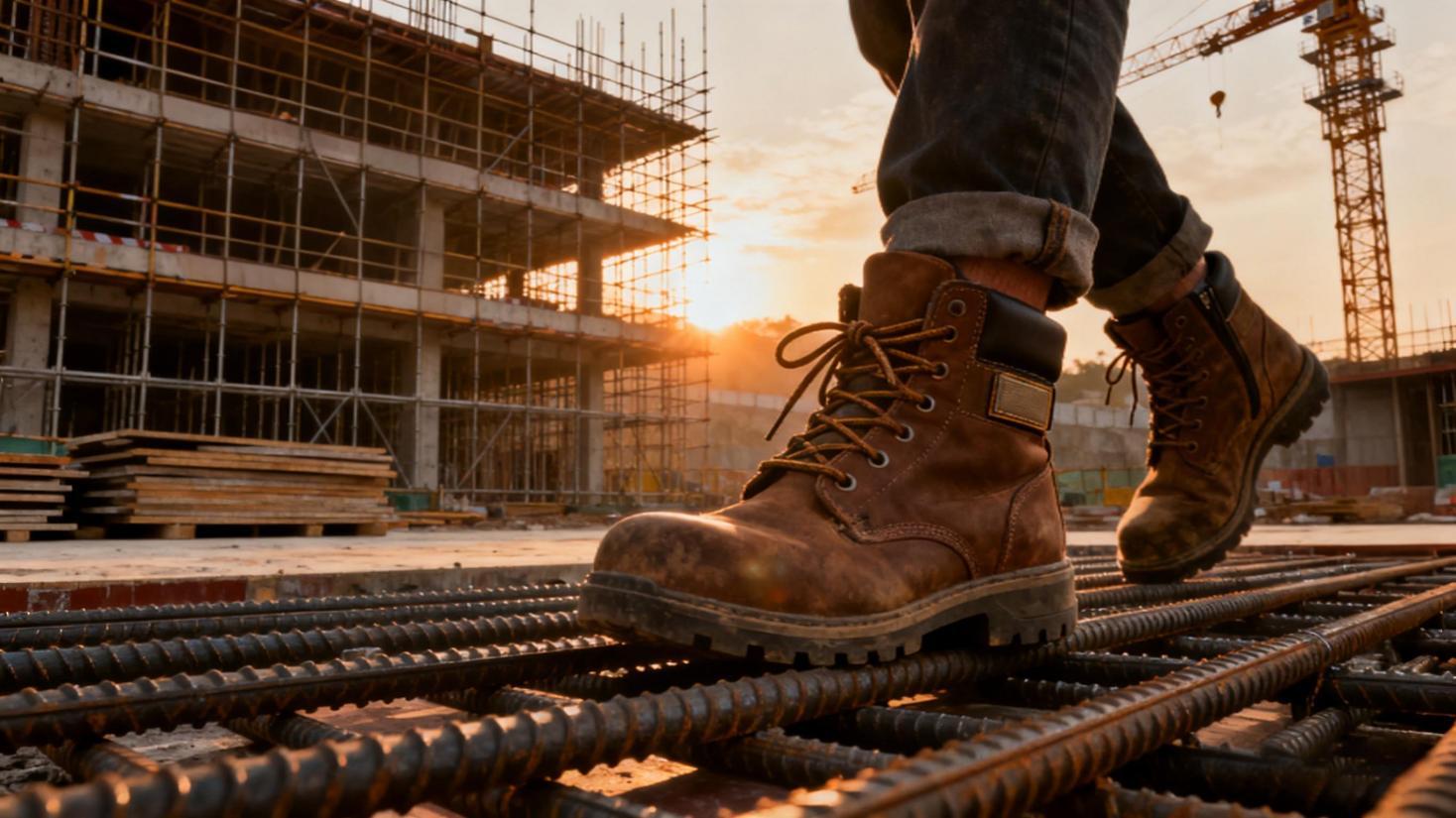
Construction sites, as high-risk operation scenarios, are fraught with risks everywhere. Safety shoes, as the core equipment for safe operations, play an irreplaceable role in standardizing construction management and safeguarding the lives and health of workers. High-quality safety shoes for construction not only need to meet the strict usage requirements of construction sites, but also cannot do without the technological research and development and quality control of safety footwear manufacturers.
As a high-quality safety footwear manufacturer, MK Safety shoes takes into account science, rigor and humanization in every link from design and research and development to production and implementation. With years of experience in the industry, it integrates the concept of “safety first, comfort foremost” into the manufacturing process of each pair of shoes. This article will focus on six core aspects An in-depth analysis of the importance of safety shoes on construction sites.
1. Construction site urgently needs safety shoes to build a solid protection baseline.
The construction site environment is complex and changeable, the construction site is full of steel, nails, gravel and other sharp objects, the cement ground is slippery and difficult to walk, the heavy machinery operation of the risk of rolling, the risk of falling from high altitude, all pose a serious threat to the safety of the construction workers’ feet.
Ordinary shoes lack targeted protective features to withstand these risks, whereas construction safety shoes are engineered with specialized materials and structures to directly address the harsh conditions of building sites.
Safety shoe manufacturers have tailored their designs for construction sites, enhancing features like slip-resistant soles, durable uppers, and impact-resistant toes. These specialized improvements transform safety shoes into a protective shield for workers’ feet, effectively reducing accident risks at the source.
2. Construction site safety shoes must comply with industry standards.
Safety shoes for construction sites must meet the S3 safety rating and comply with the EN ISO 20345 standard to be used on-site. The following core requirements must be satisfied:
- anti-break performance
The shoe toe must pass a 200-joule impact test, with an internal toe compression resistance of at least 15kN to prevent toe injuries.
- penetration resistance
The sole must withstand 1100N static pressure without puncture, preventing penetration by sharp objects such as nails or steel bars.
- non-skid property
The sole pattern design must pass the wet friction coefficient test to ensure stable performance on slippery surfaces like oily or muddy terrain.
- electrical insulation property
For electrical work, a 6kV voltage test must be conducted to prevent electric shock.
- Comfort and Durability
The upper should be breathable and durable, while the sole features shock absorption to reduce fatigue from prolonged standing.
Why must standards be met?
Construction sites are fraught with multiple hazards including falling objects from heights, sharp ground hazards, and slippery conditions. Safety shoes serve as the “last line of defense” against foot injuries. Inferior footwear that fails to meet safety standards may cause severe injuries or even amputations due to issues like deformed impact-resistant layers or punctured soles.
3. Construction safety shoes provide precise protection.
Foot injuries are among the most common workplace accidents in construction sites. Statistics show that workers who don’t wear or wear substandard safety shoes are more than three times as likely to sustain foot injuries compared to those using certified footwear.
Safety shoes for construction can provide precise protection against different types of injuries:
Anti-breakage toe guard: steel toe guard against heavy object impact, prevent toe fracture
Anti-puncture sole: blocking nails and steel bars, preventing puncture wounds on the soles of feet
Anti-slip design: special pattern for better grip and prevent slipping and injury
Safety shoe manufacturers continuously upgrade protective technologies, significantly improving the safety of these footwear products. This advancement effectively reduces foot injury rates at construction sites, ensuring the safety of workers.
4. Why is the comfort of construction safety shoes particularly important?
Fit affects the protective efficacy of safety shoes: loose fit causes friction and blisters, while tight fit hinders blood circulation. Construction sites involve high-intensity, long-duration work, where workers often suffer from foot fatigue and soreness, which ultimately reduces work efficiency.
Comfortable safety shoes help construction workers maintain peak performance during high-intensity tasks, reducing downtime from foot discomfort and boosting overall site efficiency.
5.The key to foot support.
A stable foot support stabilizes the foot structure, supports the natural arch of the foot, helps improve balance, and reduces the burden on the knee joints and lower back. The key support components include the following:
- Foot arch support
The arch of the foot naturally absorbs shock, and the structured insole keeps the foot properly aligned to reduce the load on the plantar fascia.
- Stability of trailing foot
A firm heel support prevents excessive movement inside the boot, reducing the risk of ankle twisting or rolling.
- Midsole cushioning performance
The midsole is the primary component for shock absorption. Advanced cushioning materials like PU or EVA foam are used to evenly distribute body weight, effectively reducing the impact force transmitted to the legs and spine.
- Contour foot bed
The foot bed is designed to follow the natural contours of the foot, ensuring proper alignment.
- Breathable support lining
The lining is moisture wick and helps prevent overheating, helping to maintain comfort and avoid swelling that could affect fit and support.
6.How to choose the right construction safety shoes?
- Match job scenarios
For high-altitude work, the focus is on slip-resistant soles and support stability. Welding operations require specialized safety shoes with heat-resistant and flame-retardant designs. Other scenarios may incorporate additional features like anti-piercing and insulation.
- Verify compliance and certification
After product certification, suppliers must submit comprehensive quality inspection reports, with particular emphasis on verifying compliance with industry standards for critical performance metrics including anti-drop and puncture resistance.
- Accurate measurement and size matching
Choose a size half a size larger than your regular shoes and leave room for thick socks. When trying on, ensure your toes are at least 1cm from the toe cap and the heel doesn’t slip, to prevent reduced protection or foot fatigue due to a wrong size.
- Choose durable material structures
The upper is crafted from top-grain cowhide or durable composite fabric, while the sole features PU or rubber materials. Inspect the stitching strength and anti-aging coating to ensure long-term durability in demanding construction environments.
Sum up
The importance of safety shoes in construction site is not only reflected in the direct protection of the construction workers’ foot safety, but also runs through the whole process of construction site compliance operation, efficiency improvement and safety management.
MK Safety shoes are engineered to deliver both protection and comfort, with each model meeting the highest safety standards. Whether on construction sites or factory floors, these shoes prioritize long-term comfort and peak performance for every worker.