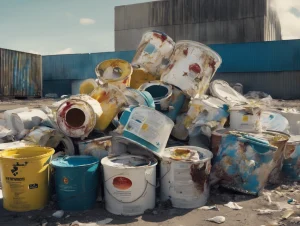
Before the Environmental Protection Act 1990 (and subsequent waste management legislation), it was not uncommon for skip hire companies to dispose of construction waste via methods such as incineration, burying waste, or simply sending it to landfill.
Amid growing awareness of the impact created by straight-to-landfill waste, construction companies and waste disposal management services are taking steps to maximise the use of finite resources while keeping used materials in circulation for longer.
Skip Hire and Construction Waste Management
Despite these changes, many assume that skip waste ends up in landfill. However many waste management services, like this skip hire London service, are increasingly conscious of their waste disposal practices, with the majority of it being sorted and recycled for further use.
This includes C&D (construction and demolition waste), which accounts for a large proportion of waste nationwide. According to UK Government statistics, 63.0 million tonnes of non-hazardous C&D waste were produced by England alone in 2022, with 59.4 million tonnes being recovered for re-use and recycling.
Responsible C&D Waste Management: The Benefits
In addition to environmental benefits, considerate C&D waste management also helps construction companies to:
- Promote a positive business reputation. Strengthening customer and client relationships.
- Minimise waste disposal costs associated with landfill tax.
- Reduce health and safety risks to employees and workers due to materials being disposed of or discarded incorrectly.
- Ensure legal compliance surrounding waste management.
Uses for Recovered Construction Waste
Some C&D waste materials (such as wood, paper or timber) can be turned into new products or can be converted into biomass fuel, compost or mulch. Similarly, materials like metals, glass, paper and plastic can be separated, cleaned and repurposed.
However, these are considerably less sustainable, given their extensive lifecycle (plastics in particular can take anywhere up to thousands of years to biodegrade). In this case, the priority is to minimise the use of brand-new materials by keeping recycled non-biodegradable materials in circulation for as long as possible.
The Challenges of “Downcycling”
Not all recycling methods are created equal – with some having more environmental benefits than others. A large portion of recovered C&D was materials such as asphalt, brick, and concrete are processed into aggregates to be used in the construction of roads and new-builds.
Although this is effectively classed as recycling, the aggregation process itself also means original, higher-value products are often “downcycled” into lower-value, non-recyclable products, consuming a large amount of energy in the process and often ending up in landfill, ultimately adding to (rather than reducing) the problem of long-term waste.
Old Materials, New Solutions
While a significant amount of progress has been made in terms of waste management since the early 1990s, it’s also important to not discount the considerable proportion of C&D waste (an estimated five million tonnes) still sent to landfill each year, or methods such as incineration, which releases harmful pollutants affecting air, water and soil.
One suggested solution to the problem of downcycling is to deconstruct, rather than demolish buildings in order to preserve and salvage more materials in their original form. While developments have yet to be made at scale, on-site practices such as careful site waste management and the use of sustainable materials can act as a preventative measure to help keep C&D waste under control.