The primary function of site screening panels has always been practical, securing a construction or development site from public access and protecting the surrounding area from the activity within. But the conversation around site enclosures has expanded significantly. Privacy management, community perception, brand communication, and the visual impact of a development on its immediate environment are all now part of how thoughtful developers and contractors approach their hoarding strategy. The blank board is no longer an acceptable default, and the reasons why go well beyond aesthetics.
Why Privacy Has Become a More Prominent Consideration
The density of urban development, particularly in London and other major cities, means that construction sites increasingly border residential properties, active commercial premises, and busy public thoroughfares. The activities within those sites generate noise, dust, and visual disruption that the surrounding community cannot avoid.
Site screening panels that manage privacy effectively create a clear physical and visual boundary that reduces the sense of intrusion felt by neighbouring properties and pedestrians. When that boundary is designed thoughtfully rather than installed as a minimum compliance measure, it transforms the relationship between the development and its immediate community.
The Different Dimensions of Privacy That Hoardings Address
Privacy in the context of construction hoardings is not a single requirement. It encompasses several distinct needs that a well-specified hoarding system addresses simultaneously.
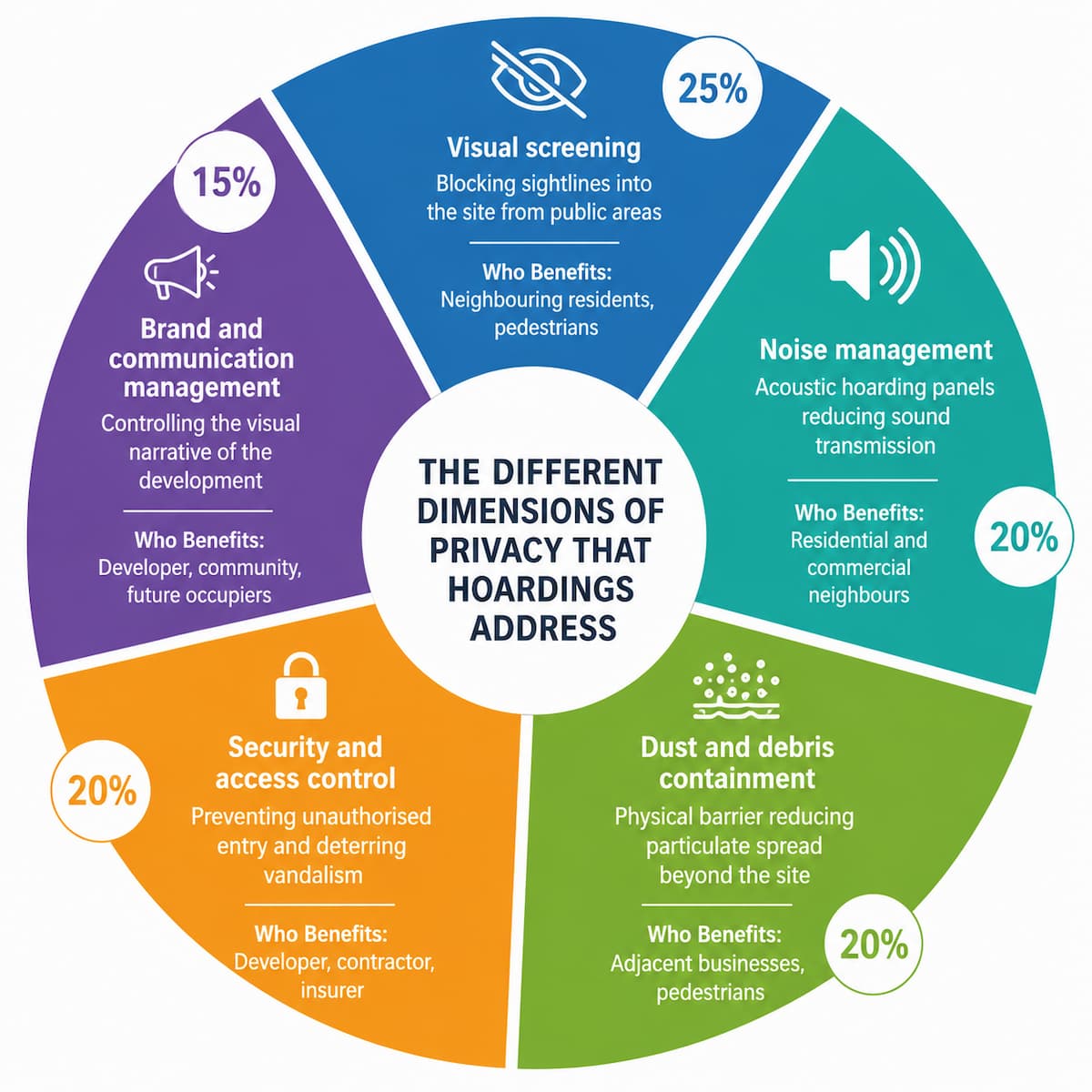
A hoarding strategy that addresses all five of these dimensions simultaneously delivers considerably more value than one designed only to meet the minimum site security requirement.
Acoustic Site Screening Panels, The Privacy Layer Most Often Overlooked
For development sites adjacent to residential properties, schools, or healthcare facilities, noise pollution is one of the most disruptive aspects of construction activity for the surrounding community. Standard site screening panels provide a visual barrier but limited acoustic benefit.
When Acoustic Hoarding Panels Are Worth Specifying
Acoustic hoarding panels, typically heavier-gauge materials with sound-absorbing cores, reduce the transmission of construction noise beyond the site boundary. While they do not eliminate noise entirely, the reduction is measurable and significant in terms of the experience of neighbouring occupiers.
Specifying acoustic site screening panels is particularly relevant for:
- Sites adjacent to residential properties where construction activity runs during early morning or evening hours
- Developments close to schools or healthcare facilities where noise disruption has direct operational impact
- High-profile urban developments where community relations are a priority and noise complaints have reputational consequences
The Visual Boundary as a Community Relations Tool
The appearance of hoardings from the perspective of the surrounding community is a reflection of the developer’s attitude toward that community. Blank, deteriorating, or graffiti-covered site screening panels communicate indifference. Well-maintained, purposefully designed hoarding communicate responsibility and respect.
Beyond the baseline of maintenance, the strategic use of site screening panels to acknowledge the community actively, through local artwork, messaging that addresses community concerns, or visual content that shows what the development will contribute, transforms the hoarding from a barrier into a bridge.
Developers who take this approach consistently report better community relations throughout the build, fewer formal objections or complaints to planning authorities, and a more positive reception for the development on completion.
Privacy for Sensitive Development Types
Not all developments are straightforward construction projects, and some require a more careful approach to privacy management than others.
Development Types With Specific Privacy Requirements
Healthcare facilities: Development or refurbishment of hospitals, clinics, or care facilities requires site screening panels that protect the privacy and dignity of patients and staff using adjacent areas of the building that remain operational.
Educational facilities: School and university construction projects require temporary site barriers that prevent sightlines from the site into occupied educational spaces, and that maintain a safe, secure perimeter throughout the construction period.
Luxury residential developments: High-value residential developments benefit from temporary site barriers that communicate the quality of the finished product while preventing the site conditions from undermining the premium positioning of the development.
Retail refurbishments: Hoarding within active retail environments manage the customer experience in the adjacent trading space, maintaining footfall and brand confidence during a disruptive period.
Specification Decisions That Affect Privacy Performance
The privacy performance of a hoarding system is determined largely by the specification decisions made at the outset of the project.
Key decisions that affect privacy outcomes include:
- Panel height: standard height may be inadequate for sites adjacent to elevated residential or commercial properties that overlook the site
- Panel construction: solid panels versus mesh or branded wraps deliver very different levels of visual screening
- Gap management: joints, gates, and access points all represent potential privacy breaches if not specified and installed correctly
- Lighting: where overnight work continues, lighting management within the hoarding boundary affects both security and the disruption caused to neighbouring properties
Conclusion
The most effective hoarding strategies are those that treat privacy not as a constraint to be minimally satisfied but as an opportunity to manage the relationship between a development and its community with genuine care. When that care is visible, in the specification, the maintenance, and the communication content of the hoarding, it produces outcomes that benefit the developer, the contractor, and the community simultaneously. Hoarding Print Company works with developers and contractors who understand the full strategic value of a well-designed hoarding solution, delivering enclosures that perform on every dimension from day one of the project.
Author Bio: Nimesh Kerai
Nimesh Kerai, the Printing Head at Hoarding Printing Company London, has a proven track record of delivering large format prints of unparalleled quality to customers. He is a technical expert as well as deeply understands the market and trends. His contribution to the company’s growth is undeniable. He often loves to share his extensive industry knowledge and market insights with a larger audience through interesting blog posts.