
A single overlooked detail, a window positioned just wrong, a fence line not checked, can trigger weeks of back-and-forth objections that delay your project and inflate costs. Most planning applications don’t fail because of grand design flaws. They stumble on easily avoidable concerns that could’ve been addressed before your submission hit the council’s desk. Whether you’re extending your home, developing a site, or helping a client through the process, understanding how to reduce planning objections before submission isn’t just helpful, it’s the difference between smooth approval and months of rework. This guide walks you through the material considerations, common triggers, and proactive steps that minimise objections, speed up determination, and eventually save you time, money, and stress.
Key Takeaways
- Understanding how to reduce planning objections before submission saves time, money, and prevents costly delays caused by easily avoidable concerns.
- Focus on material planning considerations such as neighbour amenity, highway safety, and design quality, as invalid concerns like property value loss carry no formal weight.
- Engaging with neighbours early through pre-application consultation significantly reduces hostile objections and surfaces issues you may have overlooked.
- Design to meet Local Plan policies on separation distances, window positioning, and parking standards to minimise amenity and privacy impacts from the outset.
- Submit thorough supporting documents including accurate drawings, required assessments, and professional reports to build confidence and prevent consultation delays.
- Use pre-application advice from your local planning authority to identify policy conflicts and likely objections before formal submission, reducing uncertainty and strengthening your case.
Understanding What Triggers Planning Objections

Seeking professional guidance on planning objections is essential to ensure your project runs smoothy. Not all concerns carry weight. The difference between a valid material consideration and an invalid complaint shapes how officers and committees assess your application.
Material Planning Considerations vs. Invalid Concerns
Planning officers can only weigh material planning considerations, factors that relate directly to land use, design, and public interest. Valid concerns include impact on neighbour amenity, highway safety, design quality, ecology, heritage, and compliance with local policies.
What doesn’t count? Loss of property value, disruption during construction, loss of a view, boundary disputes (unless they affect land use), and competition for business. These are personal or civil matters, not planning ones.
You’ll often see objection letters packed with invalid points. Whilst neighbours have every right to raise them, they hold no formal weight. Your job is to focus your response and design on the material issues that do.
Common Objection Triggers: Amenity, Privacy, and Overlooking
Amenity is the quality of a place, how pleasant, usable, and liveable it is. Neighbouring residents protect their amenity fiercely, and objections frequently centre on:
- Overlooking: Windows or balconies that enable direct sight into private gardens or habitable rooms.
- Loss of light or overshadowing: Structures that block sunlight, especially to gardens, windows, or conservatories.
- Overbearing impact: Buildings that loom over adjacent properties, making them feel enclosed or dominated.
These triggers aren’t subjective. Officers assess them using separation distances, daylight/sunlight studies, and Local Plan policies. If your design crosses these thresholds, objections will follow, and they’ll be hard to dismiss.
Parking, Access, and Highway Safety Concerns
Parking and access objections are equally common, particularly in residential areas with limited on-street parking. Typical concerns include:
- Insufficient parking spaces for the proposed use.
- Access points that obstruct sightlines or create hazards.
- Increased traffic causing congestion or safety risks.
Local highway authorities often get consulted on these points. If they raise concerns, your application stalls. Demonstrating compliance with parking standards and safe access early on defuses most of these objections before they escalate.
Step 1: Research Your Site and Local Context Before Designing

Good planning begins long before you sketch your first floor plan. Understanding your site’s constraints and opportunities prevents costly redesigns later.
Review Neighbouring Properties and Potential Impact Zones
Walk your site. Look at neighbouring properties from multiple angles. Note:
- Which windows face your boundary?
- Where are gardens, patios, or outdoor spaces?
- What’s the current relationship between buildings, distances, heights, orientations?
Use tools like Google Street View and satellite imagery to map impact zones. Measure approximate distances. If you’re proposing a two-storey extension 8 metres from a neighbour’s kitchen window, expect objections.
Check planning history or past objections on the council’s portal. Have neighbours submitted applications? Were they approved or refused? What concerns came up? This reveals sensitivities and patterns.
Study Local Plan Policies and Design Guidance
Every council has a Local Plan with policies on design, amenity, parking, and heritage. Supplementary Planning Documents (SPDs) often add detail, required separation distances, parking ratios, and design standards.
Download and read them. Highlight clauses relevant to your project. If a policy states “21 metres between facing habitable windows,” don’t design for 18 metres and hope for flexibility.
Look at recent appeal decisions in your area. The Planning Inspectorate publishes these online. They show how policies get interpreted and what arguments succeed or fail.
Step 2: Engage with Neighbours and Stakeholders Early

One of the most underused strategies is simply talking to people. Early engagement doesn’t guarantee zero objections, but it significantly reduces hostile ones.
Why Pre-Application Consultation Reduces Objections
When neighbours discover a planning application through a formal notice, it feels like an ambush. They react defensively, often objecting on principle before fully understanding the proposal.
Pre-application consultation flips this dynamic. You control the narrative. You explain your plans, listen to concerns, and adjust before submission. Neighbours who feel heard are far less likely to object, or if they do, their concerns will be more specific and easier to address.
Consultation also surfaces issues you might’ve missed: a forgotten footpath, a tree they cherish, or a sensitive window you didn’t notice.
How to Communicate Your Proposal Effectively
Don’t rely on technical drawings alone. Neighbours aren’t architects. Use:
- Simple sketches or 3D visuals showing the proposal from their perspective.
- Plain language descriptions of what you’re building and why.
- Face-to-face meetings or letters, not just emails. Personal contact builds trust.
Be honest about impacts. If your extension will partially overlook a garden, acknowledge it and explain mitigation (frosted glass, screening). Transparency reduces suspicion.
Document these conversations. Notes and emails become evidence that you’ve engaged constructively, a point in your favour if objections do arise.
Step 3: Design to Minimise Amenity and Privacy Impacts
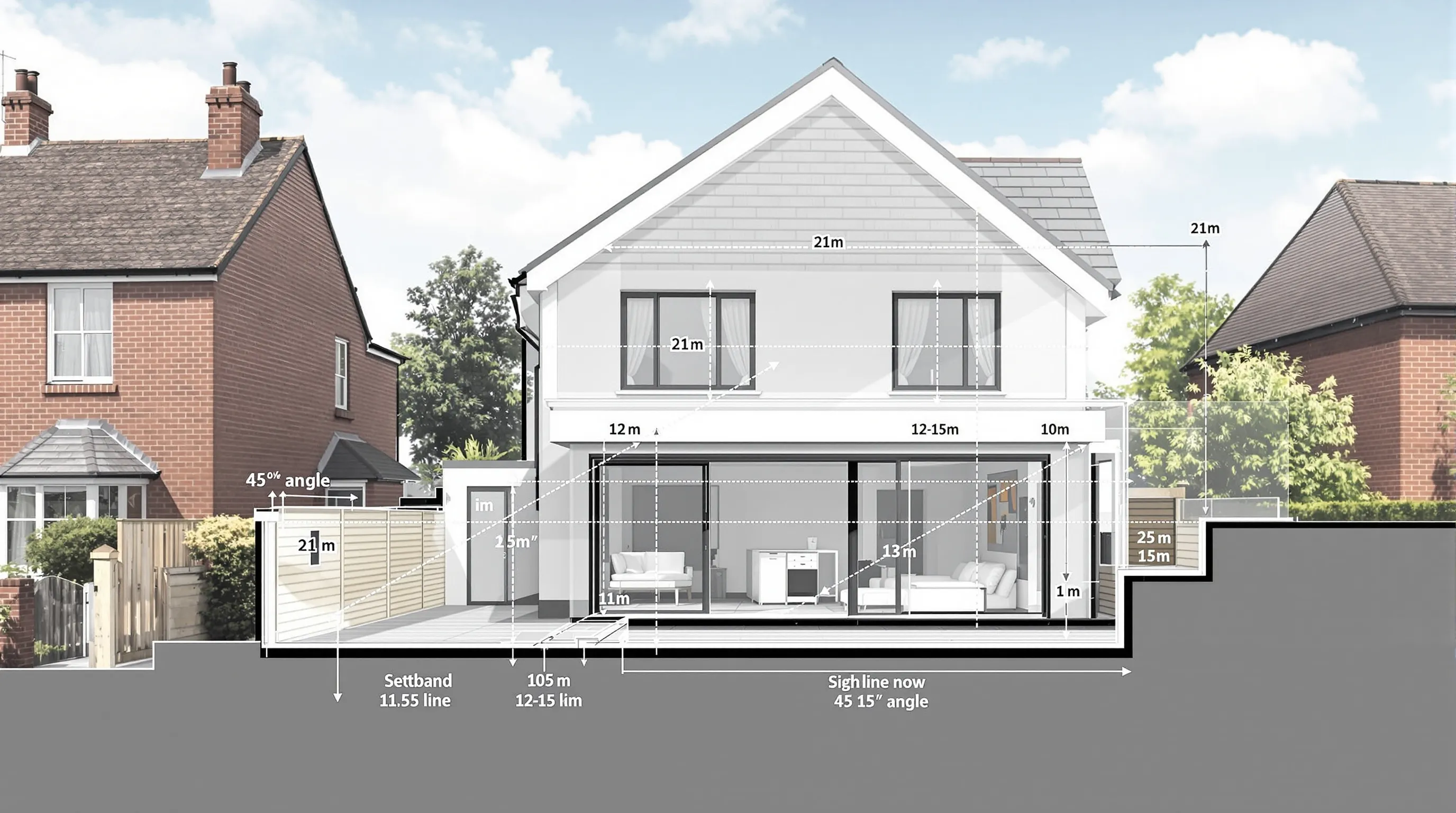
Smart design choices at the outset prevent most amenity objections. You don’t need to compromise your project, you just need to position elements thoughtfully.
Setbacks, Separation Distances, and Window Positioning
Most Local Plans specify minimum separation distances:
- 21 metres between habitable room windows facing each other (typical standard).
- 12–15 metres from habitable windows to boundaries or blank walls.
- 10 metres from non-habitable windows (bathrooms, stairs) to boundaries.
These aren’t absolute rules, but deviations require strong justification. If you can’t meet them, consider:
- Positioning windows to avoid direct sight lines.
- Using obscure glazing or high-level windows.
- Offsetting windows from neighbours’ windows.
Setbacks from boundaries also reduce overbearing impact. A two-storey extension right on the boundary feels oppressive: one set back 2–3 metres breathes easier.
Mitigating Overshadowing and Overbearing Effects
Overshadowing objections often hinge on sunlight access. Extensions on north or east boundaries cast less shadow on neighbours’ gardens. South or west extensions need careful design.
Use the 45-degree rule: from a neighbour’s nearest habitable window, draw a 45-degree line upward and sideways. If your proposal sits outside these lines, impact is likely acceptable.
For overbearing impact:
- Keep ridge heights lower than the neighbouring property where possible.
- Step massing down towards boundaries.
- Use pitched roofs instead of flat parapets to soften bulk.
Providing a daylight/sunlight assessment (BRE guidelines) for sensitive schemes shows due diligence and preempts objections.
Step 4: Address Parking and Access Requirements Proactively

Parking objections derail applications fast, especially in suburban or rural areas. Demonstrating compliance early avoids delays.
Demonstrate Adequate Parking Provision
Local Plans specify parking standards, often:
- 1 space per 1-bed dwelling
- 2 spaces per 2–3 bed dwelling
- 3 spaces per 4+ bed dwelling
Commercial and mixed-use projects have their own ratios. Check your council’s standards.
Show parking clearly on your site plan. Include:
- Dimensions of each space (typically 2.4m x 4.8m minimum).
- Turning areas if required.
- Accessible parking if applicable.
If you can’t meet standards, justify it. Urban sites near public transport may qualify for reduced provision. Provide evidence: transport links, walk scores, historic use.
Ensure Safe and Compliant Access Arrangements
Highway safety objections focus on visibility, access width, and traffic generation.
For vehicle access:
- Demonstrate adequate visibility splays (sightlines at exits). Local highway authorities specify these.
- Ensure access width meets standards (typically 3–4.8 metres depending on use).
- Avoid access onto busy roads or near junctions/bends.
For pedestrian safety:
- Show safe routes from parking to entrances.
- Avoid conflicts between vehicles and pedestrians.
If your proposal increases trips significantly, a Transport Statement or Assessment may be needed. Consult the highway authority early, they can kill applications with a single objection.
Step 5: Prepare Thorough and Professional Supporting Documents

Your drawings and reports tell the story of your proposal. Poor documentation invites objections and delays: professional, comprehensive documents build confidence.
Essential Reports and Assessments to Include
Depending on your project, you may need:
- Design and Access Statement: Explains your design rationale, context, and policy compliance. Required for most applications.
- Heritage Statement: If near listed buildings or conservation areas.
- Flood Risk Assessment: For sites in flood zones.
- Ecological Survey: If trees, hedgerows, or protected species present.
- Daylight/Sunlight Assessment: For developments affecting neighbours’ light.
- Noise/Air Quality Assessments: For commercial or sensitive uses.
Don’t skip reports to save money. Missing assessments trigger consultation delays and objections from statutory consultees.
Clear Site Plans, Drawings, and Visual Context
Your drawings must be legible, accurate, and scaled correctly. Include:
- Location plan (typically 1:1250 scale) showing the site in red and adjacent land/buildings.
- Site plan (1:200 or 1:500) with existing and proposed layouts, boundaries, parking, access.
- Elevations and floor plans (1:50 or 1:100) showing all sides, levels, and window positions.
- Cross-sections through the site if levels vary or neighbour relationships are tight.
3D visualisations or photomontages help non-technical reviewers (neighbours, councillors) understand your proposal. Show views from key neighbouring properties.
Label everything. Show existing trees, fences, and features. Highlight changes clearly. Ambiguity breeds objections.
Step 6: Use Pre-Application Advice from Your Local Planning Authority

Pre-application advice is one of the best investments you can make. Most councils offer it, sometimes free for householders, sometimes for a fee, and it provides direct insight into officer thinking.
Submit a brief proposal with draft drawings. Officers will identify policy conflicts, likely objections, and required reports. They may suggest design tweaks that make approval far more likely.
This isn’t binding advice, officers can change their view once the formal application is submitted, but it significantly reduces uncertainty.
Pre-app advice also flags concerns from highway officers, conservation teams, or environmental health early. Fixing issues before submission avoids consultation delays and objections later.
Attend planning committee meetings before your submission. Watch how members debate applications. You’ll learn what concerns them, how they interpret policy, and which arguments resonate. This insight shapes your submission strategy.
Responding Constructively If Objections Are Received
Even with perfect preparation, objections can still arrive. How you respond matters as much as your original design.
How to Review and Assess Objection Validity
Once your application goes live, objections appear on the council portal. Read every one carefully.
Separate material concerns from invalid ones. Focus your response on:
- Amenity impacts (overlooking, overshadowing, overbearing).
- Highway safety and parking.
- Design quality and policy compliance.
- Heritage, ecology, or other technical matters.
Ignore personal attacks, property value claims, or construction disruption complaints, they carry no weight.
For material concerns, assess honestly: is the objection valid? Does your design genuinely cause harm? If so, can you adjust?
Making Design Adjustments or Providing Additional Information
If an objection highlights a real issue, fixing it strengthens your application. Options include:
- Repositioning or resizing windows.
- Adding screening or landscaping.
- Reducing height or bulk.
- Providing additional parking or access improvements.
Sometimes objections stem from misunderstanding. Provide clarification:
- Annotated drawings showing separation distances.
- Daylight studies proving no significant light loss.
- Comparisons with neighbouring extensions already approved.
Submit amendments or additional information formally via the council portal. Make sure the planning officer sees it.
Communicating Your Response to the Planning Officer
Officers review objections and weigh them against policy. Contact your case officer to discuss concerns. Ask:
- Which objections do they consider valid?
- What evidence or adjustments would address them?
- Is the application likely to be recommended for approval?
Provide a written response to objections summarising:
- Which concerns you’ve addressed and how.
- Why other objections aren’t material or justified.
- Supporting evidence (studies, precedents, policy clauses).
Stay professional. Defensive or dismissive responses alienate officers and councillors. Frame your response as problem-solving, not combative.
If objections are numerous or influential, consider engaging directly with objectors. Sometimes a phone call or meeting resolves misunderstandings and leads to objections being withdrawn.
Common Mistakes to Avoid When Preparing Your Application
Even experienced applicants make avoidable errors. Watch out for these pitfalls:
- Skipping neighbour engagement. It’s tempting to avoid difficult conversations, but surprise applications generate hostile objections.
- Ignoring Local Plan policies. Assuming flexibility or hoping officers overlook conflicts rarely works. Design to policy first.
- Incomplete or poor-quality drawings. Ambiguous plans invite objections and requests for clarification, delaying determination.
- Missing statutory reports. Submitting without required ecological, heritage, or flood risk assessments triggers consultation delays.
- Underestimating parking or access concerns. These technical objections are hard to overturn without clear evidence.
- Defensive responses to objections. Dismissing concerns or arguing emotionally damages your credibility with officers.
- Missing deadlines. Councils set consultation periods and decision timelines. Missing deadlines for amendments or responses weakens your position.
- Over-designing. Pushing boundaries too far, maximum height, minimum setbacks, leaves no room for compromise if objections arise.
Finally, don’t assume approval just because neighbours didn’t object. Officers assess policy compliance independently.
Final Checklist Before Submission
Before you hit submit, run through this checklist to catch last-minute issues:
Policy and Context:
- Local Plan policies reviewed and design aligns.
- SPDs and design guides consulted.
- Recent appeal decisions and precedents checked.
Neighbour and Amenity:
- Separation distances meet or exceed standards.
- Window positions avoid direct overlooking.
- Overshadowing and overbearing impacts minimised.
- Neighbours consulted and concerns noted.
Parking and Access:
- Parking provision meets Local Plan standards.
- Access dimensions and visibility splays compliant.
- Highway authority consulted if needed.
Documentation:
- All required reports and assessments included.
- Drawings accurate, scaled, and clearly labelled.
- 3D visuals or photomontages provided.
- Design and Access Statement comprehensive.
Pre-Application:
- Pre-application advice received and incorporated.
- Officer feedback addressed.
Final Review:
- Application form complete and fee correct.
- All documents uploaded and readable.
- Site notices and neighbour notification requirements understood.
Double-check everything. A single missing document can delay determination by weeks.
Conclusion: Turning Objections into Opportunities for Better Design
Reducing planning objections isn’t about gaming the system or hiding impacts. It’s about doing the assignments, understanding your site, respecting neighbours, and designing thoughtfully within the framework of local policy. Every step you take before submission, researching context, engaging early, demonstrating compliance, builds a stronger case and reduces friction.
Objections, when they do come, aren’t always roadblocks. Sometimes they highlight genuine issues you missed, prompting design improvements that make the project better for everyone. Responding constructively, with evidence and flexibility, shows officers and councillors that you’re serious about delivering good development.
Planning is a negotiation, not a battle. Treat it as such, and you’ll move through the process faster, with fewer headaches and better outcomes. Your next approval starts with the choices you make today, before the application ever goes live.
Frequently Asked Questions
What are material planning considerations when reducing planning objections?
Material planning considerations include factors directly related to land use, such as neighbour amenity, privacy impacts, highway safety, design quality, ecology, and heritage. These carry formal weight in planning decisions, unlike invalid concerns such as loss of property value or views.
How can I reduce planning objections before submission?
Reduce objections by researching your site and Local Plan policies, engaging neighbours early through consultation, designing to minimise amenity impacts with proper setbacks and window positioning, demonstrating compliant parking provision, and preparing professional supporting documents before submission.
Why is pre-application consultation important for planning applications?
Pre-application consultation prevents hostile objections by allowing you to explain proposals, listen to concerns, and adjust designs before formal submission. Neighbours who feel heard are significantly less likely to object, and you can identify overlooked issues early.
What separation distances are required between properties to avoid overlooking objections?
Most Local Plans require approximately 21 metres between facing habitable room windows, 12–15 metres from habitable windows to boundaries, and 10 metres from non-habitable windows. Meeting these standards prevents most privacy and overlooking objections.
How do I respond to planning objections once they are received?
Review objections to identify material concerns versus invalid ones. Respond constructively with evidence such as daylight studies or annotated drawings, make design adjustments if needed, and communicate professionally with the planning officer to address valid concerns without defensiveness.
Can I get planning permission if my neighbours object?
Yes, planning permission can still be granted despite neighbour objections. Planning officers assess applications based on material planning considerations and Local Plan policies, not the number of objections. Valid concerns must be addressed, but invalid complaints carry no formal weight in the decision.