
Structural strength once meant adding more material and accepting higher costs. Today, it demands smarter decisions. Buildings must resist fatigue, environmental stress, and changing use without constant repair. Engineers now measure strength by performance over decades, not just initial load capacity.
Advances in materials science and manufacturing are transforming the construction industry. Smart materials respond to stress, while precision fabrication ensures components perform as intended. When these disciplines align, structures gain durability, efficiency, and reliability from early design through construction and long-term operation.
Smart Materials and Their Impact on Long-Term Structural Integrity
Material behaviour now plays a far more active role in structural performance than it once did. Instead of degrading in predictable ways, modern engineered materials can respond to stress, moisture, temperature variation, and repeated loading. This responsiveness allows structures to maintain integrity under real-world conditions rather than idealised design assumptions.
In construction, materials such as self-healing concrete, fibre-reinforced composites, and shape-memory alloys are increasingly specified where fatigue and micro-damage pose long-term risks. These materials can slow crack propagation, adapt to movement, and retain strength in environments that would compromise traditional solutions. The result is not just improved durability, but greater confidence in how a structure will perform years after completion.
However, material capability alone does not guarantee lasting strength. Advanced materials often require tighter dimensional control and more accurate interfaces to function as intended. Without precise fabrication and assembly, their properties can be diminished, introducing vulnerabilities rather than resilience.
Manufacturing Precision as a Foundation for Structural Reliability
Structural reliability is often compromised not by poor design, but by small inaccuracies introduced during fabrication. Even minor deviations in tolerances, surface finishes, or alignment can alter load paths and accelerate fatigue in complex assemblies.
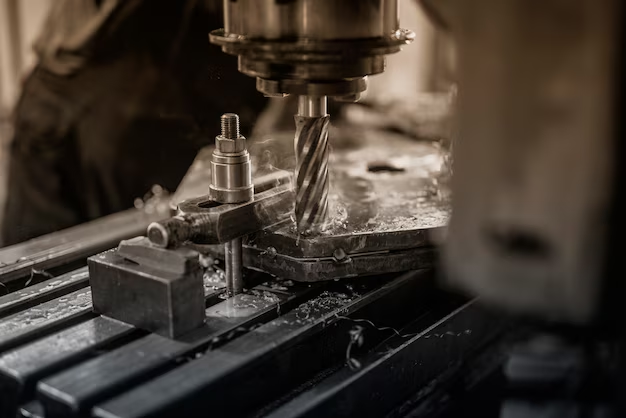
Digitally controlled fabrication methods, such as CNC milling, make it possible to achieve consistent accuracy across complex components. This level of precision supports even stress distribution and reduces unintended stress concentrations that weaken structures over time, particularly in load-bearing or movement-sensitive elements.
At the procurement stage, cost and accuracy must be considered together. Requesting a CNC quote online helps project teams assess whether precision-machined components can be produced within the allotted budget, reducing the risk of late-stage compromises that undermine structural performance.
When fabrication aligns closely with both design intent and cost expectations, precision becomes an invisible advantage. Components fit as expected on site, assemblies perform predictably, and structural assumptions remain valid throughout the building’s service life.
Reducing Structural Risk Through Informed Specification
Structural risk often emerges when assumptions made during design are not fully carried through to specification. Ambiguous tolerances, undefined interfaces, or overly generic material descriptions can lead to substitutions or adjustments during fabrication that compromise performance.
Informed specification reduces this risk by clearly linking design intent to measurable requirements. Defining acceptable tolerances, surface conditions, and assembly expectations helps ensure that components produced through CNC milling behave as predicted once installed. It also limits the likelihood of on-site modifications that introduce unplanned stresses.
Clear specifications support better collaboration between designers, manufacturers, and contractors. When requirements align with the realities of CNC milling capability, potential issues can be identified earlier, making them easier and less costly to resolve.
By treating specification as a risk management tool rather than a formality, construction teams can protect long-term structural integrity. Decisions made on paper translate more reliably into built outcomes that perform as intended over the life of the structure.
Prototyping and Validation Before Full-Scale Fabrication
Assumptions made during design do not always translate cleanly into physical outcomes. Small discrepancies in geometry, assembly sequence, or load behaviour can emerge once components are produced, even when drawings appear complete.
Early validation helps expose these issues before they are multiplied at scale. Physical prototypes and trial assemblies allow teams to observe how parts fit together, how loads transfer across interfaces, and whether tolerances behave as expected under realistic conditions.
Testing at this stage also provides an opportunity to refine details without disrupting the programme or the budget. Adjustments made during prototyping are far less costly than corrective work once full production or site installation is underway.
Avoiding Geometry-Induced Weak Points in Advanced Materials
Smart and advanced materials often fail not because of insufficient strength, but because geometry undermines their performance. Sharp internal corners, abrupt section changes, and poorly resolved transitions can create localised stress concentrations that negate the benefits of otherwise high-performing materials.
This risk is heightened when working with smart or engineered materials that respond dynamically to load. Their behaviour depends on controlled deformation and predictable stress distribution. Inconsistent geometry can restrict that response, leading to premature cracking, delamination, or loss of adaptive function under repeated loading.
Precision fabrication plays a critical role in mitigating these weaknesses. CNC milling allows complex forms to be produced with smooth transitions, controlled radii, and consistent feature definition. This geometric control helps preserve the intended stress paths and supports uniform material behaviour across the component.
Structural Strength as a System, Not a Single Component
In practice, performance emerges from how elements interact rather than from any single member acting alone. Load paths, connections, sequencing, and tolerances determine how forces move through a structure and how effectively they are resisted over time.
Isolating components during design can create hidden vulnerabilities. Even a robust element may underperform if it is misaligned, poorly connected, or constrained by neighbouring components. System behaviour, not individual capacity, ultimately governs reliability.
A system-based approach encourages designers to consider interfaces, movement, and compatibility from the outset. This reduces the likelihood of localised weaknesses that compromise overall behaviour under real loading conditions.
By focusing on interaction and coordination, construction teams can achieve resilience without unnecessary material or complexity. Strength becomes the outcome of coherence across the entire structural system.
Wrapping Up
Lasting structural strength is achieved when material capability, geometry, and fabrication accuracy work together rather than in isolation. Smart materials deliver their benefits only when supported by precise manufacturing and well-informed technical decisions.
By aligning design intent with advanced CNC milling and disciplined specification, construction teams reduce risk and preserve performance. Strength becomes a predictable outcome, not a hopeful assumption, resulting in structures that remain reliable, resilient, and fit for purpose long after completion.